Free Sheep Course & Champion’s Feeding Formula Ebook
Shearing
Shearing Your Lamb’s Body
Published - 07:00
Slick shearing the body of your lamb is the first step. You will want some large show clippers that can be fit with a surgical, fine or covercoat blade set. If you are shearing routinely at home and not for the show, you can use a fine or covercoat blade on your lamb. These blades leave the wool longer and are really nice if it is cold. If you just have small clippers with the numbered blades, a #10 blade is similar in length to a covercoat. You can use a #10, but it will probably take you a lot longer to get the job done and might dull them faster.
To properly put your blades on your big show clippers, tighten your blades all the way down, and then loosen them one and a quarter turn. Make sure you oil your blades at the beginning as well as throughout the shearing process.
For the shows, I recommend you shear the day before or the day of the show. Never shear your lamb more than five days ahead. If you shear early, the wool will grow too much by show day. You will use surgical blades for the main body. This will be the neck, top, sides, and the muscle of the legs. This will take off all the wool down to the skin. Be careful with surgical blades as it is easier to cut or burn the lamb. Check the temperature of your blades regularly by turning them off and placing your hand on the back of the blade. If they are too hot to the touch, let them cool down before continuing or spray them with a cooling solution.
Let’s get into some specifics for shearing. One tip for slick shearing is to take long smooth strokes across the lamb’s body. At the neck, shear by going upwards towards the face to help with the illusion of a tall pretty front.
On the body, make your strokes lengthwise from the shoulder to the tail, helping the sides to look smooth and long. Once you have finished the body of your lamb, it is best to rinse and blow out the wool again. After blowing it out, you go over the body one more time to make sure everything is perfectly even and smooth. By going the extra mile here, your presentation on show day will give you another subtle edge.
On the rear legs, you go up, down, or forward, but don’t slick shear down onto the lower leg wool. Stay above the hock as you shear the body of your lamb. Make every pass slightly overlap the last so that you leave no trace of a line anywhere on the lamb. You want the shearing job to be nearly perfect.
You will usually use fine blades for the lamb’s face, since surgical blades can make the face look too bald. At the time of writing this book, many showmen are leaving ear wool long. This is a style so see what showmen are doing at the time that you are showing. You can use fine blades, covercoat blades, or even a #10 on the belly of the lamb behind the chest and rack. Often about half way between the front and rear legs is where you begin to blend. You will have to learn how to blend whenever you go from a short to a long blade and you will want to learn exactly where those transitions should be. The current style wants that tucked up chest and deep belly, so the shearing is done to help that look. You want to keep the wool on the belly short enough that it isn’t obvious that you are leaving it on and blend it to look as natural as possible.
These are show sheep, so we want them to look natural and subtle. You don’t want a slick sheared lamb with a huge puff of wool on their belly. Always lean on the side of being subtle. Make sure also that all the long wool is underneath the belly and none on the sides of the lamb.
Having a pair of small hand clippers is really helpful as well. Have a #10 blade with guards so that you can adjust the length. I sometimes use a #10 blade on the lamb’s face and belly since these clippers are really small and easy to maneuver around the headpiece on a stand without taking the lamb off. They are also quieter and don’t bother the lamb as much. The #10 blade is about the same length as a covercoat blade so if you want to save money you can use your #10 blade.
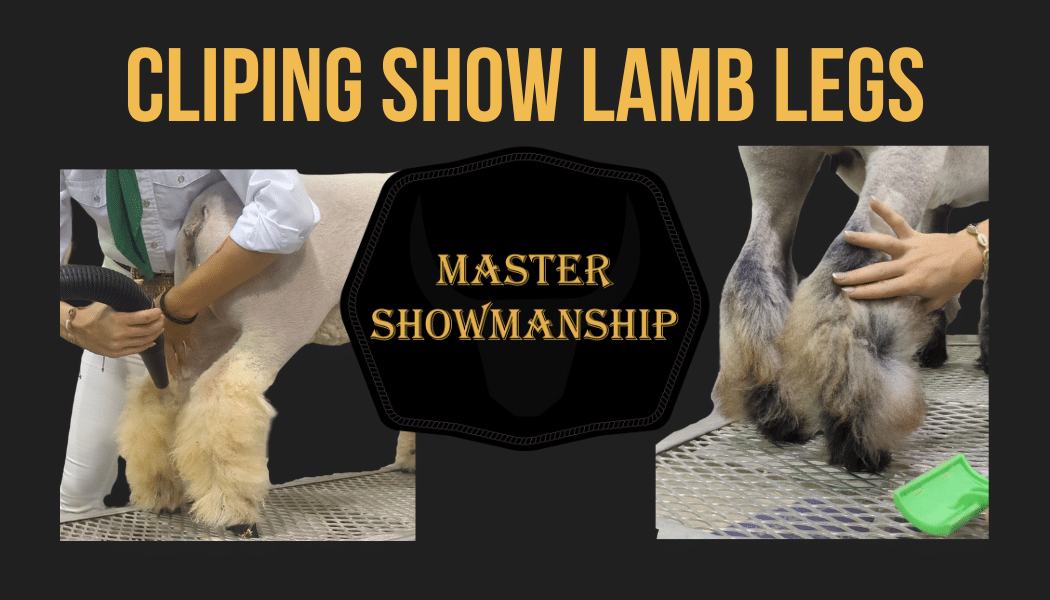
Clipping your show lambs legs!
If you are interested in clipping your lamb’s legs, I have two video lessons going into great detail on how to do this really well. Those videos are done and will be available soon with the full course – Master Showmanship Academy. The full course is not yet available, but if you want to be in the ‘beta group’, get a discount on the course, and be in the first class ever – let me know at: tarajaynelivestock@gmail.com
I am willing to start the course sooner if I know there is a group ready to begin!